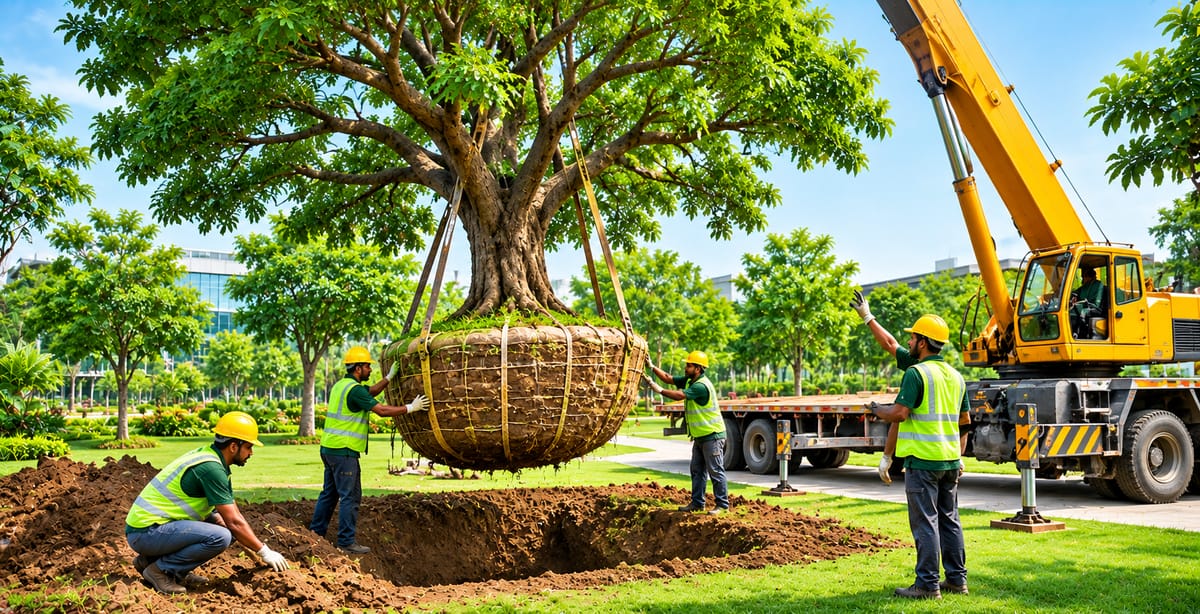
How Mature Tree Relocation Works: Process, Techniques and Benefits of Saving Old Trees
Mature trees are valuable natural assets that take decades to grow. They provide shade, improve air quality, support biodiversity, and contribute to the environmental balance of cities and communities. However, during road construction, infrastructure development, commercial projects, and urban expansion, many established trees face the risk of removal.
Instead of cutting these trees, mature tree relocation offers an environmentally responsible alternative. It involves carefully uprooting an established tree, protecting its root system, transporting it, and replanting it at a suitable new location.
Today, Mature Tree Relocation Services India are becoming increasingly important for real estate developers, infrastructure companies, government organisations, and corporate institutions seeking sustainable development solutions.
With scientific planning, specialised machinery, and proper aftercare, many mature trees can be successfully transplanted and continue growing in their new surroundings.
1. What Is Mature Tree Relocation?
Mature tree relocation, also known as tree transplantation, is the process of shifting an established tree from its original location to another suitable site without unnecessarily damaging its essential root system.
Unlike ordinary plantation, mature tree transplantation requires specialised equipment, technical knowledge, and careful handling.
It is commonly required for:
- Road widening and highway development.
- Metro and railway infrastructure projects.
- Corporate campuses and industrial developments.
- Residential townships and commercial buildings.
- Government and public infrastructure projects.
- Landscaping and urban redevelopment.
The primary objective is to preserve valuable existing trees while allowing development activities to continue responsibly.
2. Why Is Tree Relocation Important?
Mature trees provide environmental benefits that newly planted saplings cannot immediately replace.
Relocating suitable trees instead of cutting them offers several advantages:
- Preserves Established Greenery: Relocation provides an opportunity to conserve trees that have already developed substantial trunks, branches, and root systems.
- Supports Sustainable Development: Infrastructure and construction projects can consider tree conservation alongside development requirements.
- Maintains Landscape Value: Established trees contribute to the visual character of residential areas, corporate campuses, and public spaces.
- Supports Urban Biodiversity: Mature trees provide potential habitats and food sources for birds, insects, and other organisms.
- Reduces Unnecessary Tree Removal: Relocation can provide an alternative when a healthy, suitable tree conflicts with planned construction.
However, not every tree is suitable for transplantation. Tree health, species, size, root condition, season, and the availability of a suitable destination must be assessed before proceeding.
3. Step-by-Step Mature Tree Transplanting Process
Professional tree relocation contractors India follow a planned process to reduce transplantation stress and improve the chances of successful establishment.
Step 1: Tree Health Assessment
The first step involves evaluating the tree's overall condition.
Experts examine its species, age, height, trunk diameter, canopy structure, root development, and general health.
They also inspect the surrounding soil and available space to determine whether relocation is technically feasible.
Step 2: Site Inspection and Planning
The original and destination locations are inspected before relocation.
Important considerations include:
- Accessibility for machinery.
- Soil conditions and drainage.
- Available space for root development.
- Transportation distance.
- Suitable planting location.
- Environmental and local permissions.
Proper planning helps minimise unnecessary disturbance during transplantation.
Step 3: Tree Root Ball Preparation
Root ball preparation is one of the most important stages of mature tree transplantation.
A root ball is the portion of soil and roots retained around the tree during excavation. Maintaining sufficient healthy roots helps support the tree after relocation.
The preparation process may include:
- Determining suitable root ball dimensions.
- Excavating carefully around the root system.
- Retaining essential roots and surrounding soil.
- Securing the root ball using suitable protective materials.
- Minimising root damage and moisture loss.
For certain large or sensitive trees, advance root pruning may be recommended to encourage new feeder root development before the actual shifting process.
Step 4: Scientific Tree Shifting Methods
Once the root ball is prepared, suitable equipment and lifting methods are selected according to the tree's size, weight, and location.
Scientific tree shifting methods may involve:
- Hydraulic tree transplantation machinery.
- Cranes and specialised lifting equipment.
- Mechanical root ball excavation.
- Protective support structures.
- Specialised transportation arrangements.
The objective is to move the tree carefully while minimising damage to its trunk, branches, and roots.
Step 5: Safe Transportation
Large tree relocation services require proper transportation planning.
The tree must be securely supported during loading and movement. The root ball should remain protected, and excessive vibration, physical damage, and moisture loss should be minimised.
Transportation arrangements depend on tree dimensions, road access, distance, and applicable transport regulations.
Step 6: Replantation at the New Location
The destination site should be prepared before the tree arrives.
The planting pit must accommodate the root ball and provide suitable soil and drainage conditions.
The tree is positioned carefully, backfilled with appropriate soil, and supported where necessary.
Correct planting depth and stable positioning are important for successful establishment.
Step 7: Post-Transplantation Care and Monitoring
Relocation does not end after replanting. Trees require ongoing attention while adapting to their new surroundings.
Post-transplantation care may include:
- Appropriate irrigation.
- Soil moisture monitoring.
- Mulching around the root zone.
- Structural support where required.
- Monitoring for pests and diseases.
- Regular assessment of new growth.
Survival depends on the tree species, health, transplantation technique, weather, and quality of aftercare.
4. Techniques Used for Large Tree Relocation
Different trees require different transplantation techniques.
- Root Ball Transplantation: A suitable quantity of soil and roots is retained around the tree to protect its root system during shifting.
- Mechanical Tree Spade Method: Specialised equipment is used to excavate and lift trees with a prepared root ball. This method is suitable for certain tree sizes and site conditions.
- Crane-Assisted Relocation: Cranes and lifting equipment help shift large trees where conventional machinery cannot be used effectively.
- Advance Root Pruning: Selected roots are pruned in advance to encourage feeder root development and prepare the tree for transplantation.
The appropriate technique is determined through professional assessment rather than applying the same method to every tree.
5. Benefits of Scientific Tree Transplantation
Scientific transplantation offers environmental and practical advantages for suitable mature trees.
- Tree Conservation: Helps preserve established trees instead of immediately resorting to removal.
- Environmental Responsibility: Supports greener infrastructure and urban development.
- Landscape Preservation: Retains valuable greenery in commercial and residential environments.
- Corporate Sustainability: Provides organisations with an option to incorporate tree conservation into environmental initiatives.
- Long-Term Green Value: Successfully established mature trees can continue providing shade, habitat, and landscape benefits.
Tree transplantation is not a guaranteed survival solution, but professional planning and continued care can improve the chances of success.
6. Where Are Mature Tree Relocation Services Required?
Mature tree relocation is useful across several development sectors.
- Government and Infrastructure Projects: Road expansion, metro construction, highways, and public development projects.
- Corporate Campuses: Relocating trees during office expansion, industrial construction, and campus redevelopment.
- Real Estate Developments: Preserving established trees during residential township and commercial building construction.
- Educational and Healthcare Institutions: Shifting trees while renovating or expanding campuses.
- Residential Properties: Relocating trees during bungalow, farmhouse, and villa development.
Experienced tree relocation contractors India can assess individual project requirements and recommend suitable transplantation solutions.
7. Pansare Nursery – Professional Tree Transplantation Services in India
Pansare Nursery, located in Kashti, Shrigonda, Ahilyanagar, Maharashtra, has more than 50 years of experience in the nursery industry.
The organisation provides tree transplantation and green infrastructure solutions for residential properties, corporate campuses, infrastructure developments, institutions, and government projects.
Its mature tree relocation services focus on:
- Tree health assessment and project planning.
- Scientific root ball preparation.
- Specialised machinery and equipment.
- Safe lifting and transportation.
- Professional replantation.
- Post-transplantation care and monitoring.
Pansare Nursery also supports corporate and institutional projects that require responsible tree conservation and sustainable landscaping solutions.
Explore its Tree Transplantation Services to understand the available solutions for residential, commercial, and infrastructure projects.
For larger developments, discover Corporate Tree Transplantation Services for institutional landscaping, infrastructure projects, and corporate environmental initiatives.
Conclusion
Mature tree relocation is an important approach to balancing infrastructure development with environmental conservation. By shifting suitable established trees instead of removing them, developers and organisations can help preserve valuable greenery and maintain the natural character of developed spaces.
The process requires proper tree assessment, root ball preparation, specialised machinery, safe transportation, scientific replantation, and continuous aftercare.
For developers, government organisations, corporate institutions, and property owners, choosing experienced Mature Tree Relocation Services India is essential for planning responsible tree transplantation projects.
Pansare Nursery supports tree conservation through professional transplantation services, helping development projects move forward while giving suitable mature trees an opportunity to continue growing.
Frequently Asked Questions
What is mature tree relocation?
Mature tree relocation is the process of carefully uprooting an established tree, protecting its root system, transporting it, and replanting it at another suitable location.
How does mature tree transplantation work?
It involves tree health assessment, site planning, root ball preparation, excavation, lifting, transportation, replantation, and post-transplantation care.
What is a tree root ball?
A root ball is the soil and root mass retained around a tree during transplantation to protect essential roots and support successful establishment.
Can large and old trees be relocated?
Yes, certain large and old trees can be relocated depending on their species, health, root structure, size, and site conditions. Professional assessment is essential.
What machinery is used for large tree relocation?
Depending on the project, hydraulic tree spades, cranes, specialised excavation equipment, and heavy transportation vehicles may be used.
How long does a transplanted tree take to recover?
Recovery varies according to species, tree size, season, root damage, and aftercare. Some trees may take several months or longer to establish new roots and show healthy growth.
Where can I find tree relocation contractors in India?
Pansare Nursery provides tree transplantation services for residential, corporate, institutional, and infrastructure projects. Contact its team to discuss your tree relocation requirements.

